Sorry for the long absence. Part of the reason was because of a bunch of doctors appointments. A few weeks ago, I had a medical procedure and was under doctor's orders to spend 24 hours recovering at home. No work, no responsibilities, nothing. The post-care instructions warned that I shouldn't even "make important decisions or sign anything." Naturally, I was overjoyed that I had 24 hours in which nothing could separate me from knitting and embroidery except some drowsiness in the beginning. The next day, I spent several hours crafting to my heart's content. I made so much progress on my "in-between" project, which I have been working on in between releases of the Once Upon a Time squares and Mysterious Halloween Town clues. I ended the day happy that I made so much progress.
The day after, I got on the bus to work and brought my knitting bag. I've been dabbling with knitting on the bus so that I have more time at home to embroider. I took out the scarf I am making for the public library's craft bazaar and started knitting a row.
OH CRAP.
Pain shot through my back, neck, and upper arm. I was having a muscle spasm again, one that made it painful for me to ride the bus. I ended up not getting any work done that day because the pain was so debilitating. The pain lasted for several days. So much for progress.
It was entirely my fault. That's what happens when I sit and craft for long periods of time without breaks to stretch or stand. I haven't found a way to fix the ergonomics of how I sit to avoid it, but I should still remember to take a break about every 20 minutes.
During this time, I had to fight the urge to pick up a project. My annoyance and anger at not being able to do my hobbies was almost as bad as the muscle pain itself. I just want to knit a scarf--is that too much to ask? This was one of those times when I feel like working on craft projects crossed over from pleasant hobby to obsession. I threw myself into it so thoroughly that it actually resulted in bad physical consequences (other than the occasional pricked finger.)
I had an epiphany related to this over the summer. While I have a lot to be thankful for, there are also areas of my life that are disappointing. My progress has stalled. There are times when I put in so much work, only to receive no positive results.
When I learned embroidery, it felt like a beacon of hope in the midst of all that disappointment. I realized that it is the only area of my life where I have complete control. I decide the materials that go into it, and what the final outcome will be. The progression of my skills is obvious, and gives me pride in my improvement. When I complete a project, I feel a sense of satisfaction that is not reliant on having other people approve my work. And yet, people love my work! Through this new interest, I have tapped into a wonderful community of friends that accept me as I am while encouraging me to set new goals.
With so many positives, it is easy to see why I have thrown myself into crafting--why I now consider it to be a part of my identity instead of one hobby among many. And yet, I also realize that there can be too much of a good thing. During a frustrating meeting, it's easy for my mind to wander into "I'd rather be stitching" territory, but I can't give in to the urge to withdraw to my craft corner.
I can embroider to relax after a busy day, but not to retreat from a challenging day.
I can embroider for enjoyment, but not to avoid trying new endeavors--even if those endeavors end up not turning out the way I want.
I can embroider to sooth my anxiety, but not to distract myself when I genuinely need to see a therapist.
I need to maintain a sense of balance. One area that I can start work on is in my crafting supplies. I realized that part of the reason I feel so much pressure to craft long hours is because I have amassed a large number of patterns. I felt guilty about the number of patterns I have in my "craft queue" and thought that I needed to work as much as I could in order to get through them all.
Next week, I will talk about my plan to eliminate this source of pressure--by going on a "supply diet."
Tuesday, September 30, 2014

Tuesday, September 9, 2014
Torah Mantle (Part 2)
It was a long journey, but this weekend I finally completed the Torah mantle.

I worked on the final patch over the weekend during brunch at Home Ec. As I worked the final appliqué stitches, I actually felt myself getting choked up--because I was nearing the end of my largest and most significant project to date, and because I wished that Auntie was here to see it.
Over the several months I worked on this project, I learned a lot of important lessons that I will carry with me as I continue to hone my skills.
1. Ingenuity
With its polyester (?) woven fabric and construction, I had to figure out entirely new strategies for stitching compared with what I had done in the past. My solution was to embroider designs onto cotton fabric patches, then sew the patches onto the fabric. The result was a design that was easier to stitch while adding more color, which is what my customer wanted. You can see the individual patches in my Flickr album. If I am open to new ideas, I can stitch with more unusual materials.
2. Entrepreneurship
This was my first commission, and I have a much better sense of how I will deal with paid work if I choose to do it again in the future. I learned to get as many details as I can, and to advocate for myself while also listening to the customer's needs.
During this time, I was reading a thread on "Ravelry" in which knitters and crocheters gave ideas on how to respond if someone says "you could sell those!" Many people would answer, "I do this as a hobby. If I sold them, that would be work, and work isn't fun." That is a real concern when considering whether to turn a hobby into a business. Suddenly, you can't just make anything you want because you need to devote some time to the project that you are selling. I discovered some tricks that helped me balance my crafting time.
For example, while I was in the final stages of sewing on the patches I did all of my work at Home Ec. It was easier to sew there because I could lay the cover flat on a table and avoid distractions. (Note: I don't consider chai tea and mocha-frosted cookies to be distractions.) The cover was bulky, so I began keeping it at my day job's office to avoid lugging it back and forth on the bus. I discovered that when I kept my commission work in a separate physical location from my house, I was much happier and relaxed at home. If it wasn't in my house, I did not feel the pressure to work on it 24/7. Lots of artists and crafters rent out studio space in which to work. That won't be possible for a long time, but I now understand the psychological value of maintaining separate work and home spaces.
3. Perseverance
There were times when the project felt overwhelming, and I was so close to giving up. After waiting for the panic to subside, I would come upon an answer that made the job easier. My customer was depending on me, and believed that I could do a great job. Sticking to it was worth it, and I feel like now I can accomplish anything!

As I held the finished project, I said a prayer known as the Shechecheyanu. It is an all-purpose prayer to thank G-d for bringing us to this moment in time, and it seemed appropriate to say on a new work of creation. May I continue to create beautiful objects and grow as an artist!
I worked on the final patch over the weekend during brunch at Home Ec. As I worked the final appliqué stitches, I actually felt myself getting choked up--because I was nearing the end of my largest and most significant project to date, and because I wished that Auntie was here to see it.
Over the several months I worked on this project, I learned a lot of important lessons that I will carry with me as I continue to hone my skills.
1. Ingenuity
With its polyester (?) woven fabric and construction, I had to figure out entirely new strategies for stitching compared with what I had done in the past. My solution was to embroider designs onto cotton fabric patches, then sew the patches onto the fabric. The result was a design that was easier to stitch while adding more color, which is what my customer wanted. You can see the individual patches in my Flickr album. If I am open to new ideas, I can stitch with more unusual materials.
2. Entrepreneurship
This was my first commission, and I have a much better sense of how I will deal with paid work if I choose to do it again in the future. I learned to get as many details as I can, and to advocate for myself while also listening to the customer's needs.
During this time, I was reading a thread on "Ravelry" in which knitters and crocheters gave ideas on how to respond if someone says "you could sell those!" Many people would answer, "I do this as a hobby. If I sold them, that would be work, and work isn't fun." That is a real concern when considering whether to turn a hobby into a business. Suddenly, you can't just make anything you want because you need to devote some time to the project that you are selling. I discovered some tricks that helped me balance my crafting time.
For example, while I was in the final stages of sewing on the patches I did all of my work at Home Ec. It was easier to sew there because I could lay the cover flat on a table and avoid distractions. (Note: I don't consider chai tea and mocha-frosted cookies to be distractions.) The cover was bulky, so I began keeping it at my day job's office to avoid lugging it back and forth on the bus. I discovered that when I kept my commission work in a separate physical location from my house, I was much happier and relaxed at home. If it wasn't in my house, I did not feel the pressure to work on it 24/7. Lots of artists and crafters rent out studio space in which to work. That won't be possible for a long time, but I now understand the psychological value of maintaining separate work and home spaces.
3. Perseverance
There were times when the project felt overwhelming, and I was so close to giving up. After waiting for the panic to subside, I would come upon an answer that made the job easier. My customer was depending on me, and believed that I could do a great job. Sticking to it was worth it, and I feel like now I can accomplish anything!
As I held the finished project, I said a prayer known as the Shechecheyanu. It is an all-purpose prayer to thank G-d for bringing us to this moment in time, and it seemed appropriate to say on a new work of creation. May I continue to create beautiful objects and grow as an artist!
Thursday, August 28, 2014
Gone Bloggin (Part 2)
Check out Part 2 of my guest blogging at &Stitches e-zine, where I reveal how my fair items fared and the lessons I learned this year.
Don't Fear the Fair (Part 2)
Don't Fear the Fair (Part 2)
Tuesday, August 26, 2014
Project Round-Up--8/26/2014
With all of the Fair preparations, it has been a while since I posted my progress on other projects.
The August square of the Once Upon a Time Sampler covered "The Musicians of Bremen," a fairy tale about a group of farm animals that saves the day. Not very many people I've talked to have heard of this one, but I know there was a Muppet special about it.


I never did post a final picture of my polar bear, so here he is. By now, I have gotten him framed and he is sitting on a shelf in my living room. (If you would like to learn this shading technique, Nicole has another class starting in September!)


Mysterious Halloween Town now has a haunted house.


At some point, I felt like I needed a change from backstitch and cross-stitch, so I whipped up Dropcloth Sampler of the Month's feather stitch sampler.

And to top it off, I am making progress on the Torah mantle. After completing this name plate, all I need to do is one more lion before I stitch the patches onto the cover.

You must be wondering how I find the time to do all of this. I've been stitching for at least 3 hours a day, barring some other event. Most of this is just cutting into time that I would have spent noodling around the internet, or watching TV. (Of course, I still watch TV, but now it's productive! The Simpsons marathon has been an awesome time to catch up on projects.) I think it's really helped my peace of mind to keep my hands busy, and the satisfaction of completing a project lifts my spirit.
I have also been thinking about this Cracked list on ways we sabotage our lives without knowing it. One of the points the author makes is that your life will be better in the future by way of you magically becoming someone else. We all have ideas about what we want to do or be in the future. "In 10 years, I want to have higher-paying job in IT." "In 5 years, I want to be fluent in French." And yet, we tend to not spend any time during the day actually working towards these goals. We just think it will happen, somehow. If a goal is important to you, start working on it TODAY. I have a vague idea that I want to get better at embroidery and do something significant with it. Start a business? Put my work on display? Teach classes? Whatever this goal turns out to be, I know it will require me to keep improving my skills, and I'll move closer towards that goal with every stitch I make today.
The August square of the Once Upon a Time Sampler covered "The Musicians of Bremen," a fairy tale about a group of farm animals that saves the day. Not very many people I've talked to have heard of this one, but I know there was a Muppet special about it.
I never did post a final picture of my polar bear, so here he is. By now, I have gotten him framed and he is sitting on a shelf in my living room. (If you would like to learn this shading technique, Nicole has another class starting in September!)
Mysterious Halloween Town now has a haunted house.
At some point, I felt like I needed a change from backstitch and cross-stitch, so I whipped up Dropcloth Sampler of the Month's feather stitch sampler.
And to top it off, I am making progress on the Torah mantle. After completing this name plate, all I need to do is one more lion before I stitch the patches onto the cover.
You must be wondering how I find the time to do all of this. I've been stitching for at least 3 hours a day, barring some other event. Most of this is just cutting into time that I would have spent noodling around the internet, or watching TV. (Of course, I still watch TV, but now it's productive! The Simpsons marathon has been an awesome time to catch up on projects.) I think it's really helped my peace of mind to keep my hands busy, and the satisfaction of completing a project lifts my spirit.
I have also been thinking about this Cracked list on ways we sabotage our lives without knowing it. One of the points the author makes is that your life will be better in the future by way of you magically becoming someone else. We all have ideas about what we want to do or be in the future. "In 10 years, I want to have higher-paying job in IT." "In 5 years, I want to be fluent in French." And yet, we tend to not spend any time during the day actually working towards these goals. We just think it will happen, somehow. If a goal is important to you, start working on it TODAY. I have a vague idea that I want to get better at embroidery and do something significant with it. Start a business? Put my work on display? Teach classes? Whatever this goal turns out to be, I know it will require me to keep improving my skills, and I'll move closer towards that goal with every stitch I make today.
Tuesday, August 19, 2014
Fair Highlights
I am working on part 2 of "Don't Fear the Fair" for &Stitches e-zine. In the meantime, here is a photo gallery of what I saw at the fair on Sunday.
 |
| Make your kid the cuddliest shark around. |
 |
| Best in Show--Hand Knitting, Crochet, Tatting |
 |
| Best in Show--Counted Thread Techniques, Counted Cross-Stitch |
 |
| Knitted child's dress with ram in stranded color work |
 |
| Wonder Woman sweater! |
 |
| Peacock, cross-stitch on linen |
 |
| I have a fondness for embroidery of plants with their names. |
 |
| One of those entries that completely changes my ideas on needlepoint. |
 |
| A Pokemon character, Chester Cheetah, and a happy turtle |
 |
| This crocheted owl afghan got our attention |
 |
| I'd love to do something like this with illustrations from antique Haggadahs |
 |
| The Drop-Cloth Sequel Sampler, made into a bag! |
 |
| A village made out of machine embroidered lace panels |
 |
| I don't care what the ribbon says. This is a winner in my book. |
 |
| The T-shirt quilts get . . . interesting. I never knew there were so many bad Christian T-shirts out there. |
 |
| Sharks were a popular theme this year. Influenced by Sharknado? |
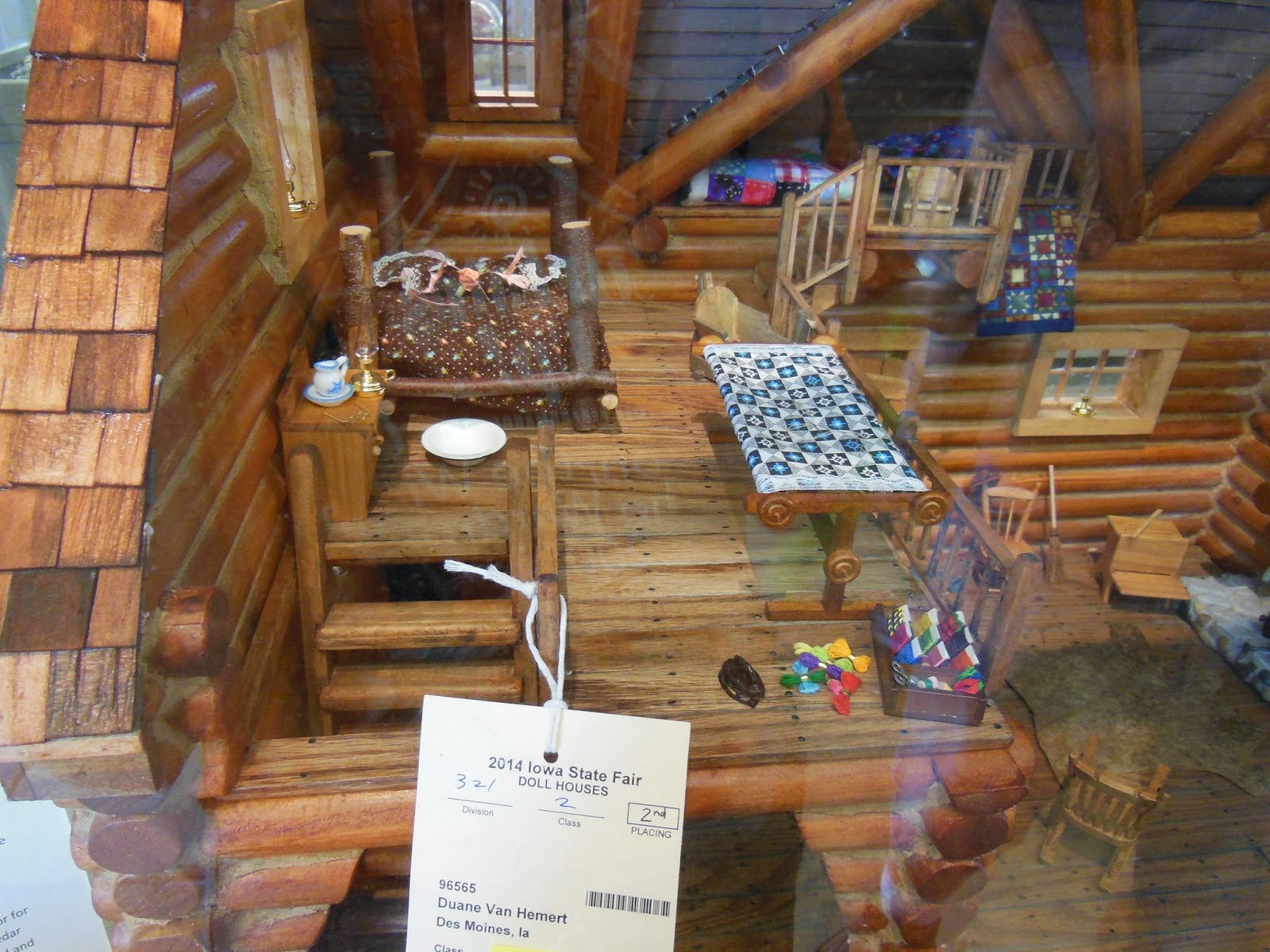 |
| A dollhouse log cabin, complete with crafting studio. Can I live here? |
 |
| Pipe cleaners protesting the poor treatment of their brethren. |
 |
| The 4-H organizers might want to think more carefully about how they arrange the entries. |
Tuesday, August 12, 2014
Gone Bloggin'
I am one of &Stitches guest bloggers for their Summer Bloggin' Series! You can read a post about my State Fair preparations by clicking the link below.
Don't Fear the Fair (Part 1)
Don't Fear the Fair (Part 1)
Friday, August 8, 2014
Slow Stitching: New Mindset or Elitist Club?
If you are a fan of cooking or fancy yourself a foodie, you have probably heard of the Slow Food Movement. Begun in 1986 after the founder was dismayed to hear a McDonalds would be opening in Rome, the movement has grown into a worldwide phenomenon. It advocates from-scratch home cooking, unprocessed ingredients, the preservation of local food ways, and taking the time to enjoy what we eat. It is probably one of the biggest influences in modern cuisine in the past several decades.
Now quilter Mark Lipinski wants to apply those principles to the fiber arts. The Slow Stitching movement is for yarncrafters and needleworkers who want put more time into their crafting, for people who want to focus more on the process of crafting instead of the end result. By doing this, the movement's founders believe that crafters can experience the following benefits:
Unfortunately, my interest in this new approach is tempered by what I have seen from the other "slow" movement. Slow Food has a lot of laudable goals, but the people behind the movement often have ideas about food that are elitist. They ignore the fact that cooking "slow food" requires access to fresh ingredients and time to prepare it, which are resources that lower-income populations do not have. Frankly, a lot of them harbor sexist beliefs. They talk about the declining quality of American food, but if you converse with them long enough, the root of their beliefs eventually comes out--that they believe home cooking got worse because women started working outside the home and no longer had time to prepare "good, wholesome" food for their families. This ignores all of the political, economic, and cultural factors that influenced the rise of processed food well before two-income households became the norm. (Also, have any of these people actually looked at a cookbook from the 1950's? The one I have from a great-aunt has an entire chapter devoted to dishes made from canned foods.)
Food and crafts are inherently different matters. Everybody needs to eat, but today very few people have to rely on crafting for daily needs. Crafters are already a self-selecting group of people, ones who can afford the supplies and have enough free time to hone their skills. I try to be aware of this and acknowledge that I have the luxury of learning how to use a sewing machine for fun when people around the world and in recent history relied on it for income. (This includes a great-grandfather of mine who died of a heart attack at his sewing machine in a factory.)
Even though the Slow Stitching movement is very new and has time to avoid the pitfalls of the Slow Food movement, I fear that it is already embracing elitist ideas. This is most obvious in their blog post about how to create a "Slow Stitching Salon." Modeled on the philosophical and intellectual gatherings popular in 17th and 18th Century France, the Slow Stitching Salon is a time for crafters to get together to discuss their projects and craft-related topics. The environment fosters inspiration and creative growth.
Nothing about this idea sounds inherently wrong, but I winced when the article emphasized that salons are NOT quilting guilds or sewing circles, which are "just giant clubs." What is wrong with these types of gatherings? These types of groups have provided a sense of purpose and camaraderie to women for centuries. They also said a stitching salon is about discussion--no actual crafting occurs, and you only bring projects for Show and Tell purposes. The very idea of a craft-related gathering without any actual crafting makes my fingers itchy.
The article also emphasizes keeping the salon artificially small in numbers, no more than 10. Keep it limited to "like-minded" and "creative people" to foster "intelligent discussion." If you run your own salon, you can hand-pick the guest list! Deny invitations to "casual" crafters or people who have a personality that doesn't mix with the rest of the group. Decide for yourself if members are allowed to bring friends.
The article claims this is just to make sure the discussion flows more easily, but where does it end? Who is a "casual" crafter? Maybe some people would define that to include people who work long hours and can spend only a small amount of time to engage in a craft they deeply love. Maybe some people would define it as someone who can only afford to get their supplies at Walmart. If your goal is to keep numbers low and define for yourself who can participate, a lot of people are left out of what can be a great experience.
I believe that crafts can be great art, and I am astounded at the ways that people can use needlework to create. I also treasure needlework as a folk art. It was done by ordinary women who used it to express themselves at a time when they had limited options. There are ways to elevate appreciation for needlework and its artistic possibilities without shutting out most of the people who do it.
Amanda from Frosted Pumpkin Stitchery wrote an interesting blog post a few months ago about how she is changing her approach to creating. Many of the tips she has are similar to the tenets of Slow Stitching, advocating that people take time to enjoy the process. She also emphasizes the importance of doing what you enjoy, and not judging other people for how they choose to spend their time. I think her tips get to the essence of Slow Stitching while remaining inclusive to the wide variety of crafters out there. No matter how expensive our materials are or how much time we have to devote to it, let's celebrate that people are still crafting in a mass-produced world.

Now quilter Mark Lipinski wants to apply those principles to the fiber arts. The Slow Stitching movement is for yarncrafters and needleworkers who want put more time into their crafting, for people who want to focus more on the process of crafting instead of the end result. By doing this, the movement's founders believe that crafters can experience the following benefits:
- Approach your creative art-making in a totally different way.
- Recharge your passion for the needle fiber arts .
- Engage the connection between your body, your quilts, and your legacy. .
- Expand your creativity, self-esteem and even your spiritual journey.
- Tap your right brain, to train and develop your imagination.
- Find the creative genius in you.
- Implement your creative thought in today’s too-fast world.
- Heal your life, emotions and boost your physical health.
- Create groups and habits to support your creative vision.
Unfortunately, my interest in this new approach is tempered by what I have seen from the other "slow" movement. Slow Food has a lot of laudable goals, but the people behind the movement often have ideas about food that are elitist. They ignore the fact that cooking "slow food" requires access to fresh ingredients and time to prepare it, which are resources that lower-income populations do not have. Frankly, a lot of them harbor sexist beliefs. They talk about the declining quality of American food, but if you converse with them long enough, the root of their beliefs eventually comes out--that they believe home cooking got worse because women started working outside the home and no longer had time to prepare "good, wholesome" food for their families. This ignores all of the political, economic, and cultural factors that influenced the rise of processed food well before two-income households became the norm. (Also, have any of these people actually looked at a cookbook from the 1950's? The one I have from a great-aunt has an entire chapter devoted to dishes made from canned foods.)
Food and crafts are inherently different matters. Everybody needs to eat, but today very few people have to rely on crafting for daily needs. Crafters are already a self-selecting group of people, ones who can afford the supplies and have enough free time to hone their skills. I try to be aware of this and acknowledge that I have the luxury of learning how to use a sewing machine for fun when people around the world and in recent history relied on it for income. (This includes a great-grandfather of mine who died of a heart attack at his sewing machine in a factory.)
Even though the Slow Stitching movement is very new and has time to avoid the pitfalls of the Slow Food movement, I fear that it is already embracing elitist ideas. This is most obvious in their blog post about how to create a "Slow Stitching Salon." Modeled on the philosophical and intellectual gatherings popular in 17th and 18th Century France, the Slow Stitching Salon is a time for crafters to get together to discuss their projects and craft-related topics. The environment fosters inspiration and creative growth.
Nothing about this idea sounds inherently wrong, but I winced when the article emphasized that salons are NOT quilting guilds or sewing circles, which are "just giant clubs." What is wrong with these types of gatherings? These types of groups have provided a sense of purpose and camaraderie to women for centuries. They also said a stitching salon is about discussion--no actual crafting occurs, and you only bring projects for Show and Tell purposes. The very idea of a craft-related gathering without any actual crafting makes my fingers itchy.
The article also emphasizes keeping the salon artificially small in numbers, no more than 10. Keep it limited to "like-minded" and "creative people" to foster "intelligent discussion." If you run your own salon, you can hand-pick the guest list! Deny invitations to "casual" crafters or people who have a personality that doesn't mix with the rest of the group. Decide for yourself if members are allowed to bring friends.
The article claims this is just to make sure the discussion flows more easily, but where does it end? Who is a "casual" crafter? Maybe some people would define that to include people who work long hours and can spend only a small amount of time to engage in a craft they deeply love. Maybe some people would define it as someone who can only afford to get their supplies at Walmart. If your goal is to keep numbers low and define for yourself who can participate, a lot of people are left out of what can be a great experience.
I believe that crafts can be great art, and I am astounded at the ways that people can use needlework to create. I also treasure needlework as a folk art. It was done by ordinary women who used it to express themselves at a time when they had limited options. There are ways to elevate appreciation for needlework and its artistic possibilities without shutting out most of the people who do it.
Amanda from Frosted Pumpkin Stitchery wrote an interesting blog post a few months ago about how she is changing her approach to creating. Many of the tips she has are similar to the tenets of Slow Stitching, advocating that people take time to enjoy the process. She also emphasizes the importance of doing what you enjoy, and not judging other people for how they choose to spend their time. I think her tips get to the essence of Slow Stitching while remaining inclusive to the wide variety of crafters out there. No matter how expensive our materials are or how much time we have to devote to it, let's celebrate that people are still crafting in a mass-produced world.
Subscribe to:
Posts (Atom)