Pages

Showing posts with label torah mantle. Show all posts

Tuesday, December 23, 2014

Looking Back at 2014

In January, I wrote a post about my stitching goals for 2014.  Let's see how I did . . .

1.  Finish, finish, finish!
This year, I managed to finish the following projects:

Winnie the Pooh Quote

Polar Bear

Drop Cloth feather stitch sampler

Torah mantle

FPS's Mysterious Halloween Town

FPS's Autumn Harvest Festival

Uncle Morrey's WWII Diary


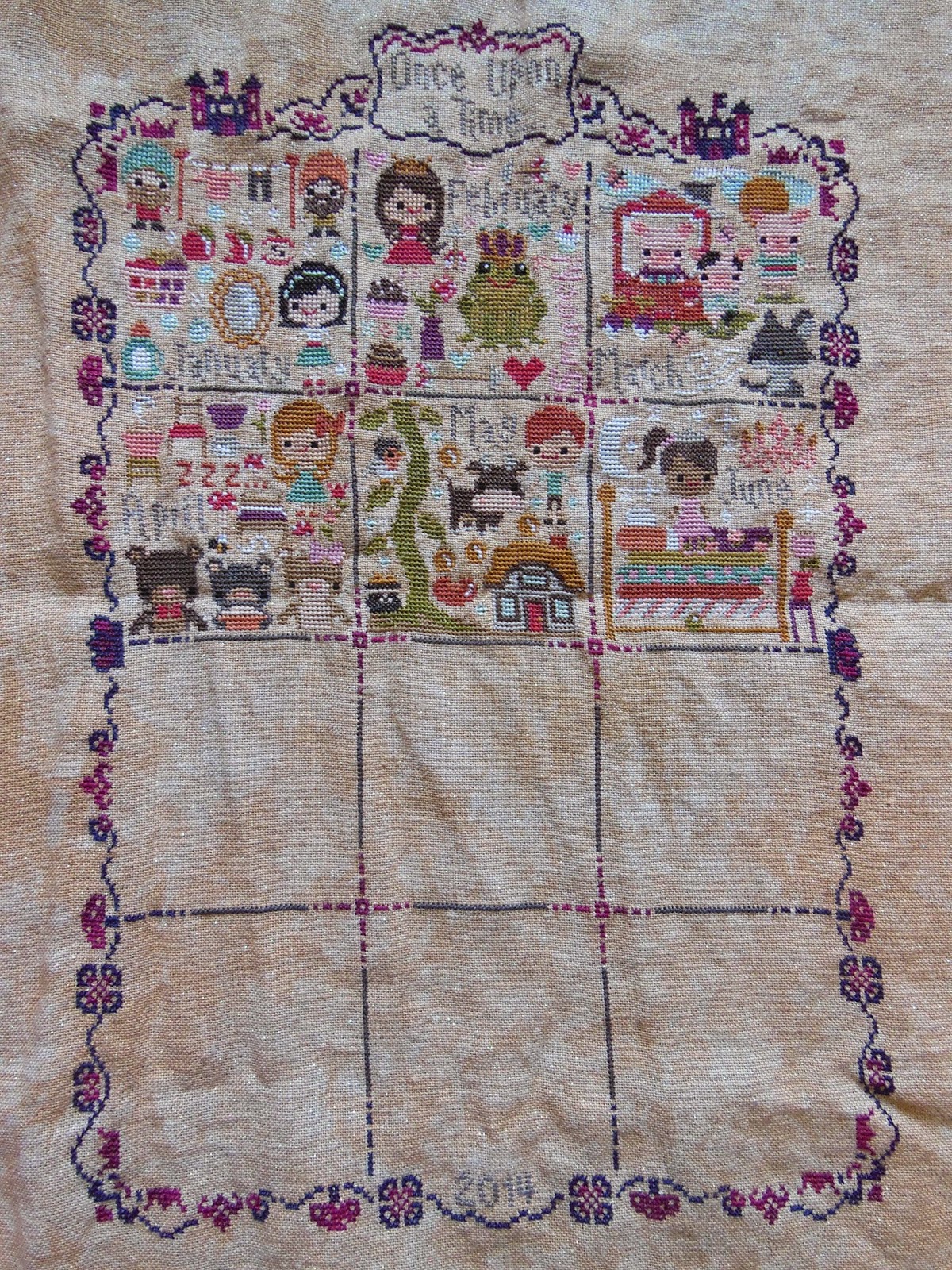
Hopefully joining these will be the Once Upon a Time sampler.  I've got a week left!

Of course, this barely makes a dent in my craft queue.  Some of these projects were really ambitious due to their size and complexity.  I think that I have finished a decent number (thanks to HabitRPG!) and I have reason to be proud of my accomplishments.

2.  Submit another entry into the State Fair.
Succeeded x3!  I got two ribbon winners, and placed higher than last year.

3.  Try a new technique for transferring patterns.
Thanks to the light pad I got for my birthday, I have now transferred several patterns through the tracing method.  It really opens up the possibilities for designing my own patterns.

4.  Learn blackwork.
I bought a kit.  Does that count?

Next week, I will share my goals for 2015.  What did you accomplish this year?

Tuesday, September 9, 2014

Torah Mantle (Part 2)

It was a long journey, but this weekend I finally completed the Torah mantle.


I worked on the final patch over the weekend during brunch at Home Ec.  As I worked the final appliqué stitches, I actually felt myself getting choked up--because I was nearing the end of my largest and most significant project to date, and because I wished that Auntie was here to see it.

Over the several months I worked on this project, I learned a lot of important lessons that I will carry with me as I continue to hone my skills.

1.  Ingenuity
With its polyester (?) woven fabric and construction, I had to figure out entirely new strategies for stitching compared with what I had done in the past.  My solution was to embroider designs onto cotton fabric patches, then sew the patches onto the fabric.  The result was a design that was easier to stitch while adding more color, which is what my customer wanted.  You can see the individual patches in my Flickr album.  If I am open to new ideas, I can stitch with more unusual materials.

2.  Entrepreneurship
This was my first commission, and I have a much better sense of how I will deal with paid work if I choose to do it again in the future.  I learned to get as many details as I can, and to advocate for myself while also listening to the customer's needs.

During this time, I was reading a thread on "Ravelry" in which knitters and crocheters gave ideas on how to respond if someone says "you could sell those!"  Many people would answer, "I do this as a hobby.  If I sold them, that would be work, and work isn't fun."  That is a real concern when considering whether to turn a hobby into a business. Suddenly, you can't just make anything you want because you need to devote some time to the project that you are selling.  I discovered some tricks that helped me balance my crafting time.

For example, while I was in the final stages of sewing on the patches I did all of my work at Home Ec.  It was easier to sew there because I could lay the cover flat on a table and avoid distractions.  (Note:  I don't consider chai tea and mocha-frosted cookies to be distractions.)  The cover was bulky, so I began keeping it at my day job's office to avoid lugging it back and forth on the bus.  I discovered that when I kept my commission work in a separate physical location from my house, I was much happier and relaxed at home.  If it wasn't in my house, I did not feel the pressure to work on it 24/7.  Lots of artists and crafters rent out studio space in which to work.  That won't be possible for a long time, but I now understand the psychological value of maintaining separate work and home spaces.

3.  Perseverance
There were times when the project felt overwhelming, and I was so close to giving up.  After waiting for the panic to subside, I would come upon an answer that made the job easier.  My customer was depending on me, and believed that I could do a great job.  Sticking to it was worth it, and I feel like now I can accomplish anything!


As I held the finished project, I said a prayer known as the Shechecheyanu.  It is an all-purpose prayer to thank G-d for bringing us to this moment in time, and it seemed appropriate to say on a new work of creation.  May I continue to create beautiful objects and grow as an artist!

Tuesday, August 26, 2014

Project Round-Up--8/26/2014

With all of the Fair preparations, it has been a while since I posted my progress on other projects.

The August square of the Once Upon a Time Sampler covered "The Musicians of Bremen," a fairy tale about a group of farm animals that saves the day.  Not very many people I've talked to have heard of this one, but I know there was a Muppet special about it.


I never did post a final picture of my polar bear, so here he is.  By now, I have gotten him framed and he is sitting on a shelf in my living room.  (If you would like to learn this shading technique, Nicole has another class starting in September!)


Mysterious Halloween Town now has a haunted house.


At some point, I felt like I needed a change from backstitch and cross-stitch, so I whipped up Dropcloth Sampler of the Month's feather stitch sampler.


And to top it off, I am making progress on the Torah mantle.  After completing this name plate, all I need to do is one more lion before I stitch the patches onto the cover.


You must be wondering how I find the time to do all of this.  I've been stitching for at least 3 hours a day, barring some other event.  Most of this is just cutting into time that I would have spent noodling around the internet, or watching TV.  (Of course, I still watch TV, but now it's productive!  The Simpsons marathon has been an awesome time to catch up on projects.)  I think it's really helped my peace of mind to keep my hands busy, and the satisfaction of completing a project lifts my spirit.

I have also been thinking about this Cracked list on ways we sabotage our lives without knowing it.  One of the points the author makes is that your life will be better in the future by way of you magically becoming someone else.  We all have ideas about what we want to do or be in the future.  "In 10 years, I want to have higher-paying job in IT."  "In 5 years, I want to be fluent in French."  And yet, we tend to not spend any time during the day actually working towards these goals.  We just think it will happen, somehow.  If a goal is important to you, start working on it TODAY.  I have a vague idea that I want to get better at embroidery and do something significant with it.  Start a business?  Put my work on display?  Teach classes?  Whatever this goal turns out to be, I know it will require me to keep improving my skills, and I'll move closer towards that goal with every stitch I make today.

Tuesday, July 29, 2014

Torah Mantle (Part 1)

After a couple hiccups, I am finally making great progress on my Torah mantle!

To refresh your memory, a Torah mantle is a cloth cover that is placed on the Torah when it is not in use in order to protect the parchment from debris.  They are usually ornately decorated, often using goldwork and applique.

As my first commissioned piece, it was very important for me to create what the customer wanted.  He had requests for symbols, some Jewish (lions, crown) and some personal (scales because he is a lawyer).  He wanted an emphasis on red, yellow, green, and blue colors.  He is also a fan of Marc Chagall, a 20th Century Jewish artist who is best known for more abstract, expressionistic work and stained glass.

With all this in mind, I found images that managed to represent the symbols he wanted without being too realistic in style.  I altered the pictures so that they were black-and-white outlines, then used printouts of these pictures to trace the design onto colored fabric.  I enjoyed using my light pad and discovering that it worked just as well with colored fabric.

I'm going for a fairly simple style with these pieces.  I'll use one color thread for each picture except for the family name, which will have a multicolored floral design.  The outlines are done in backstitch, with some other stitches for decorative details.


This is my take on a Judaic symbol known as the "Lion of Judah."  Animal imagery in Judaism has an interesting history.  It is against Jewish law to worship idols or make graven images, but Jews could never agree on whether representational art of people, animals, and plants counted as graven images.*  Sometimes, disagreements erupted even between Jews in the same community!  In Europe it was a common occurrence for a rich man to donate an item like a curtain for the Torah ark decorated with deer, only for the town's rabbis to argue over whether they could actually use it in the synagogue.

The only exception to this debate was lions.  The Twelve Tribes of Israel are each represented by a symbol, and the lion was the symbol for the tribe of Judah.  This association traces back to Genesis 49:9, when the patriarch Jacob blessed his son Judah by calling him a "young lion" (gur aryeh)  Tradition dictates that most Jews are descended from the tribe of Judah, and this is where we get the term "Judaism."  Because of this history, lions have been a popular symbol for Jewish ritual objects.


Another symbol I've made is the crown (keter).  Lots of torah mantles include this at the top of the design as a symbol of learning and G-d's majesty.  I played around with the details on this picture, using chain stitch for the band of the crown and buttonhole wheels for gems.

Once I am done with each symbol, I will sew them onto the torah mantle.  I've learned a lot at every stage of this process.  I am grateful for the opportunity to not only try doing a hobby I love professionally, but for the opportunity to grow as a Jewish artist.

*My favorite example of this issue can be found in one of the synagogues in Venice.  The walls of the sanctuary are decorated with famous Biblical scenes, but they tried to find ones where they could get away with not depicting people, flora, or fauna.  One picture is of the Red Sea after it drowned the Egyptians, with chariot wheels poking out of the water.  Another is of Moses beating a rock with his staff to bring forth water, but Moses is holding the staff from "off-stage."

Thursday, June 26, 2014

Super Mega Project Update!

I've been productive the last few weeks, and all it took was spending every free moment stitching!

First, I finished the June square for Frosted Pumpkin Stitchery's Once Upon a Time Sampler.

June 2014--The Princess and the Pea
Six down, six to go!
The mattresses were fun with all of the different patterns.  That princess looks very well rested, all things considered.

Then I completed week 5 of Follow the White Bunny's Furry Nice class.  Now my polar bear has wonderfully textured fur on his face and body.


I love the way the light hits the fur when I hold the fabric at a tilt.  Next up--satin stitch on the scarf.

I have a lot on my plate (including some projects not related to embroidery) and REALLY shouldn't be starting other projects, but Frosted Pumpkin came out with the first part of their Mysterious Halloween Town Sampler.  I have been dealing with some health issues this week and this sounded like the kind of simple, meditative project that would help put my mind at ease.  My husband saw me working on it and said, "Jorie, it's not pumpkin weather!"  This adorable little town doesn't care.

These are my friends:  Russell Crow, Cameron Crow, Crow Diddly, Hugh Crownin, Gregory Peck . . .
Mysterious blank town
There is some method to the madness of working on spooky patterns in June.  The ladies at Frosted Pumpkin Stitchery asked for feedback on how people prefer to receive holiday or seasonal patterns.  People responded with the following answers:
  1. More time to work on each section of a multi-part pattern.  Some speedy stitchers can finish a section in one week, but the rest of us are mere mortals.
  2. Release patterns far enough in advance that people can finish them before the holiday.  For some reason, people stop wanting to work on Christmas-themed patterns after December 26.
The Frosted Pumpkins listened to the feedback, and have changed the Mysterious Halloween Town pattern release accordingly.  Starting in mid-June, they are releasing one section of the pattern each month.  The final section comes out in mid-September, with several weeks to finish the entire pattern in time for Halloween.  The timetable is perfect for people who are also working on the Once Upon a Time sampler.  This way, I always have some cross-stitch to work on.

Other updates:
  • The Torah mantle has been my most difficult project to figure out, but I think I've found a workable solution.  Hopefully, I will have pictures up soon.
  • Rebecca Ringquist at Drop Cloth featured my Filling Stitches Sampler on her blog!
  • I've been selected to be a summer guest blogger at &Stitches!  I will be writing two blog posts chronicling my and my friends' efforts to infiltrate the State Fair.


Tuesday, May 27, 2014

Project Round-Up--5/27/2014

I finished the last class of my certificate program.  My university-centered job has started its summer lull.  We just got back from a relaxing beach vacation.

You know what that means, don't you?

MORE TIME FOR STITCHING!

Now, all of this free time to craft can be too much of a good thing.  Without precautions in place, the day might come where my husband will come home to find me unconscious, buried under a pile of craft supplies.  In order to make sure that I give each project the attention it deserves, I am utilizing the power of HabitRBG to keep me on track.  I set up my first negative habit--from now on, I will lose points if I start a new project when I already have a work-in-progress in that category (knitting or embroidery.)

So far, I have finished the April and May squares for the Once Upon a Time Sampler.

April--Goldilocks and the Three Bears
May--Jack and the Beanstalk

I like the Beanstalk square because Jack looks just like my nephew!

Other updates:
  • The Torah mantle I've been working on is a lot more challenging than I expected.  It is made out of a white satiny fabric with a floral pattern woven in.  This fabric was meant for wedding dresses.  That makes it difficult to stitch on--it's like I have to do embroidery on top of satin stitch.  I'm having to adapt the design I was planning to do by changing the stitches and ways that I transfer the pattern onto the fabric.
  • My end of the year tasks have delayed my ability to start the polar bear pattern for my class, but I plan on starting after I work on the Torah mantle.

Wednesday, October 30, 2013

What's My Worth?

Several weeks ago, right before Yom Kippur, I ran into the husband of a woman I am on a board with at the synagogue.  When I introduced myself, he said, "Wait, are you the one who does embroidery?"  Yes, I am.  "So you are the one who submitted that matzah cover to the state fair and got a ribbon?"  Wow, word travels fast!

He said that he has a project that I might find interesting.  Every year at the Kol Nidre service that starts Yom Kippur, my Jewish community has a tradition in which all of the torahs in the community are carried into the service and up to the bimah [stage].  (At this point, I was assuming that he was going to ask me to carry a torah during the procession.  I would have to politely decline since I haven't lifted weights in a while.)  He went on to say that his family owns a torah that they have always included in the ceremony.

When not in use, a torah is protected with a cloth covering called a mantle.  They are often very ornate, made with fine fabrics and embroidered using goldwork techniques.  During the rest of the year, they can be any color or design, but in the 10 days between Rosh Hashanah and Yom Kippur, synagogues traditionally switch to white mantles to represent our purity after atoning for sins.

Antique reproductions
The man said that he sewed a torah mantle for use during the 10 days with cloth from a wedding dress that had been in his family.  When he first made it, it had a Jewish star and torah stitched on with surface embroidery.  Since then, he has decided that he wants a more complex pattern--more colors, more Jewish symbols.  He has not been able to add more because he doesn't embroider, and he has had trouble finding someone who was both talented and familiar with Jewish symbols.  When he found out about my matzah cover, he decided to ask me.  He said that he could pay me, and we agreed to talk more after the High Holidays.

I was so elated that when I got home, I cranked up my music and danced around.  (Not to Jewish music.  I think it was "Down Under" by Men at Work.)  I felt honored to be asked to work on such an important object, and that someone would actually pay me to do it!  Then it started to sink in . . .

Pay?  PAY?  What on G-d's green earth am I going to charge?

It's a question that every crafter with a home-based business must grapple with at some point.  You have to consider the cost of materials and tools.  You have to decide on a dollar amount for the time you put into the project--your time and effort has value, and the price of the item needs to reflect that. At the same time, we are living in a world where we are so used to mass-produced items that the cost of a handmade item can produce sticker shock.

We were discussing this during brunch at Home Ec because the local library is holding its 2nd annual Arts & Crafts Bazaar.  They are accepting handmade items, which you provide with a suggested price.  The items are then sold at the Bazaar and the money goes to their summer reading program.  Several people said that they had contributed high quality handmade items--both in material and technique--only to discover that the items were sold at less than their suggested price.  This year, they are reconsidering how many items they donate, they are using cheaper or leftover materials, and they are choosing items that don't involve as much of a time commitment to make.  One Home Ec patron said that her friend used to donate knit items to her church's fundraisers, but eventually stopped because she was so hurt by the way that the organizers constantly underpriced her items.  We want to help worthy causes, but we also want our hard work to be adequately recognized.  Non-crafters do not know how many weeks it took you to knit that Fair-Isle hat, or the eye strain and finger pricks you endured while stitching a monogram onto a handkerchief with one strand of floss.

I think it makes sense to tailor your price, crafting technique, and expectations to where your items will end up.  The goal of a fundraiser is to make money for the organization, so items need to be priced to sell that day.  Save the higher quality materials and complex skills for times when customers will be expecting to pay higher prices, such as an Etsy store, a craft fair, or custom work.  Browse the internet to find out what the prices are for similar handmade items.

I also don't know whether I should factor my experience into the price.  I will be putting in my best work, but should I lower the price since I do not have years of experience behind me?

Whatever the answer, I will take care in finding it.  When I receive the torah mantle. I will take it to the owner of Home Ec to ask for advice on materials and tools.  I will keep scouring websites to get ideas on prices, and I will ask for honest opinions from my crafting friends.  Above all, I will see this as an opportunity to grow as a Jewish embroiderer--and that is priceless.