Pages

Friday, August 8, 2014

Slow Stitching: New Mindset or Elitist Club?

If you are a fan of cooking or fancy yourself a foodie, you have probably heard of the Slow Food Movement.  Begun in 1986 after the founder was dismayed to hear a McDonalds would be opening in Rome, the movement has grown into a worldwide phenomenon.  It advocates from-scratch home cooking, unprocessed ingredients, the preservation of local food ways, and taking the time to enjoy what we eat.  It is probably one of the biggest influences in modern cuisine in the past several decades.

Now quilter Mark Lipinski wants to apply those principles to the fiber arts.  The Slow Stitching movement is for yarncrafters and needleworkers who want put more time into their crafting, for people who want to focus more on the process of crafting instead of the end result.  By doing this, the movement's founders believe that crafters can experience the following benefits:
  • Approach your creative art-making in a totally different way.  
  • Recharge your passion for the needle fiber arts .
  • Engage the connection between your body, your quilts, and your legacy.        .
  • Expand your creativity, self-esteem and even your spiritual journey.
  • Tap your right brain, to train and develop your imagination.
  • Find the creative genius in you.
  • Implement your creative thought in today’s too-fast world.
  • Heal your life, emotions and boost your physical health.
  • Create groups and habits to support your creative vision.
On the surface, I think this idea is a welcome change to the instant-gratification obsessed mindset that can inhabit some crafting circles.  When I went to the state fair last year, my friend Angela was deeply impressed with many of the handcrafted items in the 4-H exhibits.  The teenagers who competed not only made exquisite-looking cabinets, benches, and other items, but they had to document their progress in a booklet.  They had to explain their reasons for the materials they picked, the construction methods they used, and the decoration they added.  They took pictures of their project at every step of the process.  Some of the projects took two years to complete!  That seems like a long time for adults, much less teenagers with short attention spans.  Obviously, not every project can take a luxuriously long amount of time, but I bet that the teens learned a lot about their chosen craft--and themselves--by having to go through an extended and thoughtful process.

Unfortunately, my interest in this new approach is tempered by what I have seen from the other "slow" movement.  Slow Food has a lot of laudable goals, but the people behind the movement often have ideas about food that are elitist.  They ignore the fact that cooking "slow food" requires access to fresh ingredients and time to prepare it, which are resources that lower-income populations do not have.  Frankly, a lot of them harbor sexist beliefs.  They talk about the declining quality of American food, but if you converse with them long enough, the root of their beliefs eventually comes out--that they believe home cooking got worse because women started working outside the home and no longer had time to prepare "good, wholesome" food for their families.  This ignores all of the political, economic, and cultural factors that influenced the rise of processed food well before two-income households became the norm.  (Also, have any of these people actually looked at a cookbook from the 1950's?  The one I have from a great-aunt has an entire chapter devoted to dishes made from canned foods.)

Food and crafts are inherently different matters.  Everybody needs to eat, but today very few people have to rely on crafting for daily needs.  Crafters are already a self-selecting group of people, ones who can afford the supplies and have enough free time to hone their skills.  I try to be aware of this and acknowledge that I have the luxury of learning how to use a sewing machine for fun when people around the world and in recent history relied on it for income.  (This includes a great-grandfather of mine who died of a heart attack at his sewing machine in a factory.)

Even though the Slow Stitching movement is very new and has time to avoid the pitfalls of the Slow Food movement, I fear that it is already embracing elitist ideas.  This is most obvious in their blog post about how to create a "Slow Stitching Salon."  Modeled on the philosophical and intellectual gatherings popular in 17th and 18th Century France, the Slow Stitching Salon is a time for crafters to get together to discuss their projects and craft-related topics.  The environment fosters inspiration and creative growth.

Nothing about this idea sounds inherently wrong, but I winced when the article emphasized that salons are NOT quilting guilds or sewing circles, which are "just giant clubs."  What is wrong with these types of gatherings?  These types of groups have provided a sense of purpose and camaraderie to women for centuries.  They also said a stitching salon is about discussion--no actual crafting occurs, and you only bring projects for Show and Tell purposes.  The very idea of a craft-related gathering without any actual crafting makes my fingers itchy.

The article also emphasizes keeping the salon artificially small in numbers, no more than 10.  Keep it limited to "like-minded" and "creative people" to foster "intelligent discussion."  If you run your own salon, you can hand-pick the guest list!  Deny invitations to "casual" crafters or people who have a personality that doesn't mix with the rest of the group.  Decide for yourself if members are allowed to bring friends.

The article claims this is just to make sure the discussion flows more easily, but where does it end?  Who is a "casual" crafter?  Maybe some people would define that to include people who work long hours and can spend only a small amount of time to engage in a craft they deeply love.  Maybe some people would define it as someone who can only afford to get their supplies at Walmart.  If your goal is to keep numbers low and define for yourself who can participate, a lot of people are left out of what can be a great experience.

I believe that crafts can be great art, and I am astounded at the ways that people can use needlework to create. I also treasure needlework as a folk art.  It was done by ordinary women who used it to express themselves at a time when they had limited options.  There are ways to elevate appreciation for needlework and its artistic possibilities without shutting out most of the people who do it.

Amanda from Frosted Pumpkin Stitchery wrote an interesting blog post a few months ago about how she is changing her approach to creating.  Many of the tips she has are similar to the tenets of Slow Stitching, advocating that people take time to enjoy the process.  She also emphasizes the importance of doing what you enjoy, and not judging other people for how they choose to spend their time.  I think her tips get to the essence of Slow Stitching while remaining inclusive to the wide variety of crafters out there.  No matter how expensive our materials are or how much time we have to devote to it, let's celebrate that people are still crafting in a mass-produced world.


Tuesday, July 29, 2014

Torah Mantle (Part 1)

After a couple hiccups, I am finally making great progress on my Torah mantle!

To refresh your memory, a Torah mantle is a cloth cover that is placed on the Torah when it is not in use in order to protect the parchment from debris.  They are usually ornately decorated, often using goldwork and applique.

As my first commissioned piece, it was very important for me to create what the customer wanted.  He had requests for symbols, some Jewish (lions, crown) and some personal (scales because he is a lawyer).  He wanted an emphasis on red, yellow, green, and blue colors.  He is also a fan of Marc Chagall, a 20th Century Jewish artist who is best known for more abstract, expressionistic work and stained glass.

With all this in mind, I found images that managed to represent the symbols he wanted without being too realistic in style.  I altered the pictures so that they were black-and-white outlines, then used printouts of these pictures to trace the design onto colored fabric.  I enjoyed using my light pad and discovering that it worked just as well with colored fabric.

I'm going for a fairly simple style with these pieces.  I'll use one color thread for each picture except for the family name, which will have a multicolored floral design.  The outlines are done in backstitch, with some other stitches for decorative details.


This is my take on a Judaic symbol known as the "Lion of Judah."  Animal imagery in Judaism has an interesting history.  It is against Jewish law to worship idols or make graven images, but Jews could never agree on whether representational art of people, animals, and plants counted as graven images.*  Sometimes, disagreements erupted even between Jews in the same community!  In Europe it was a common occurrence for a rich man to donate an item like a curtain for the Torah ark decorated with deer, only for the town's rabbis to argue over whether they could actually use it in the synagogue.

The only exception to this debate was lions.  The Twelve Tribes of Israel are each represented by a symbol, and the lion was the symbol for the tribe of Judah.  This association traces back to Genesis 49:9, when the patriarch Jacob blessed his son Judah by calling him a "young lion" (gur aryeh)  Tradition dictates that most Jews are descended from the tribe of Judah, and this is where we get the term "Judaism."  Because of this history, lions have been a popular symbol for Jewish ritual objects.


Another symbol I've made is the crown (keter).  Lots of torah mantles include this at the top of the design as a symbol of learning and G-d's majesty.  I played around with the details on this picture, using chain stitch for the band of the crown and buttonhole wheels for gems.

Once I am done with each symbol, I will sew them onto the torah mantle.  I've learned a lot at every stage of this process.  I am grateful for the opportunity to not only try doing a hobby I love professionally, but for the opportunity to grow as a Jewish artist.

*My favorite example of this issue can be found in one of the synagogues in Venice.  The walls of the sanctuary are decorated with famous Biblical scenes, but they tried to find ones where they could get away with not depicting people, flora, or fauna.  One picture is of the Red Sea after it drowned the Egyptians, with chariot wheels poking out of the water.  Another is of Moses beating a rock with his staff to bring forth water, but Moses is holding the staff from "off-stage."

Tuesday, July 15, 2014

A Far Away Place

Most of the embroidery patterns I buy now are fairly affordable.  It is usually $8-20 per pattern, depending on whether it is just a PDF document or printed on fabric.  For me, it's my affordable luxury.

Last weekend, though, it veered into ACTUAL luxury.

I follow a needlework company called The French Needle, which imports embroidery and cross-stitch patterns from France.  Their patterns are beautiful, but pricey.  Besides, my current style is patterns that are cute and/or related to pop culture.  I never really saw myself buying one in the near future.

Last week, however, one of their new patterns grabbed a hold of my imagination and did not let up until I bought it.  ABC "Les parisiennes" is a pattern of every letter in the alphabet, featuring women standing in front of Paris landmarks and wearing mid-century fashions straight from Dior or Mad Men.  It was stylish and complex, using advanced cross-stitch techniques to create a scene that was as far from old-fashioned patterns as a 1930's Hollywood movie star is from a dumpy fishwife.  I suddenly had to have it, even though it is the most expensive individual pattern I have bought so far.  (That was without shipping!)


You might be wondering why anyone in the world would buy patterns that require translation.  Really, the language barrier isn't that much of an issue.  The cross-stitch world largely speaks the language of DMC floss, and the color numbers are the same everywhere.  What little French is in the pattern is easily overcome with Google Translate.  "Point de croix 2 brins" means "Cross stitch 2 strands."

It is also fun to discover a world of needlework patterns beyond the US, with different countries having their own sense of style.  The French Needle began when the owner took her French sister-in-law to an American embroidery shop.  The SIL complained that she wasn't seeing any patterns in the style she wanted to make.  Each country has a different sense of color, line, and space that makes their style unique, and these patterns are worth seeking out.  (Japanese designers are also gaining popularity among American crafters for their inventive-yet-traditional knitting and embroidery patterns, but that might be beyond my Google Translate capabilities.)


Honestly, though, I bought it because it made me think of my great-aunt, this blog's namesake.  Auntie stuck with stamped cross-stitch patterns on plain weave fabric, so she would have never made a pattern with this much detail.

The real connection is that she was a world traveler.  I grew up hearing her tell the stories of her experiences, the same stories she told my mom and aunts.  One of my favorites was about her going to Paris with a group of friends.  One day, the group split up for separate activities.  Auntie and one friend went to buy opera tickets, while the rest of the group went glove shopping.  As Auntie approached the box office, she realized that they did not have enough money to cover the tickets.  A man in line offered to buy the tickets for them as long as they paid him back later.  Their only solution . . . ask the rest of the group to return the fancy gloves they had just bought.

When I saw the pattern, it made me think of Auntie as a young professional woman.  She was born into a poor immigrant family in Chicago, and through her hard work managed to earn enough money to visit one of the most exciting cities in the world.  Maybe she preferred the opera over gloves, but did she dress with just a little bit more glamor?  What other sites did she see?  What people did she meet?

My grandmother taught me how to knit when I was six.  In high school, I discovered the world beyond knit and purl, and I enjoyed showing my grandmother all the new projects I did that went beyond the skills she taught me.

Today, I sometimes feel sad that Auntie will never see my work.  She'll never see me learn new stitches, never see my projects of increasing complexity, never see the ribbons I win at the State Fair. ( I know she and my grandmother would shout "Hooray!")  I can take comfort in the fact that she still inspired me to explore this new world that brings me joy--a world that includes both the thrill of visiting a foreign land and the thrill of completing a beautiful piece of art.

Tuesday, July 8, 2014

Project Round-Up--7/8/2014

Nothing much happening except some diligent stitching.

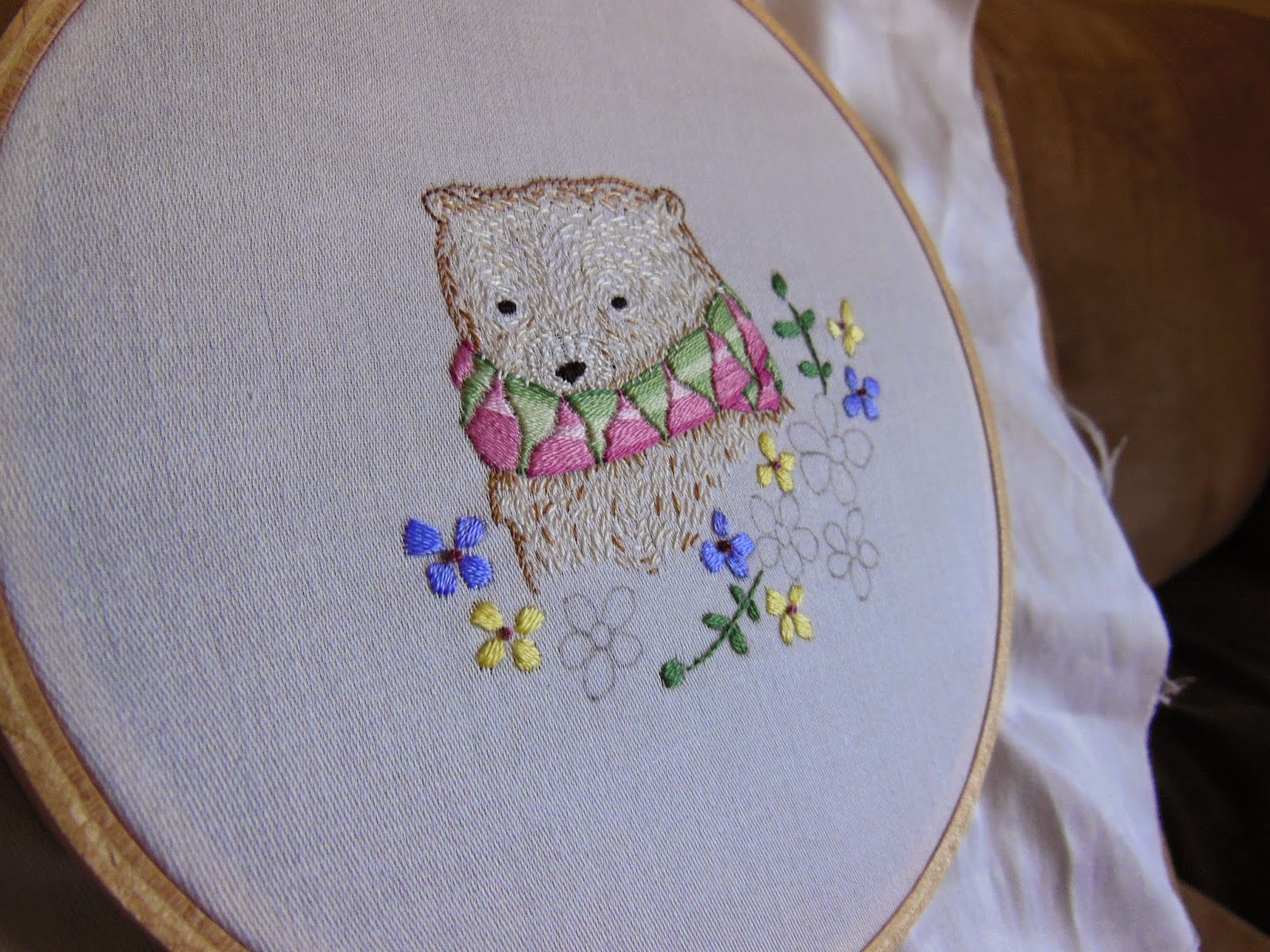
My polar bear is in the home stretch, with the scarf and small flowers completed.


I originally thought I could do the scarf in a variegated thread, but the lessons specifically called for picking out three threads of one color in dark, medium, and light values.  By using these colors in satin stitch, it gives the scarf a "rounded" appearance, as if the light is hitting the scarf in a certain way.  The result actually looks like a scarf, and not some sort of Elizabethan white ruff that everyone thought it was before it was completed.  


If you look at this closeup picture, you can see some light white threads stitched over the scarf, as if some fur is poking out over the scarf.  I love how this gives the polar bear a slightly scruffy appearance.

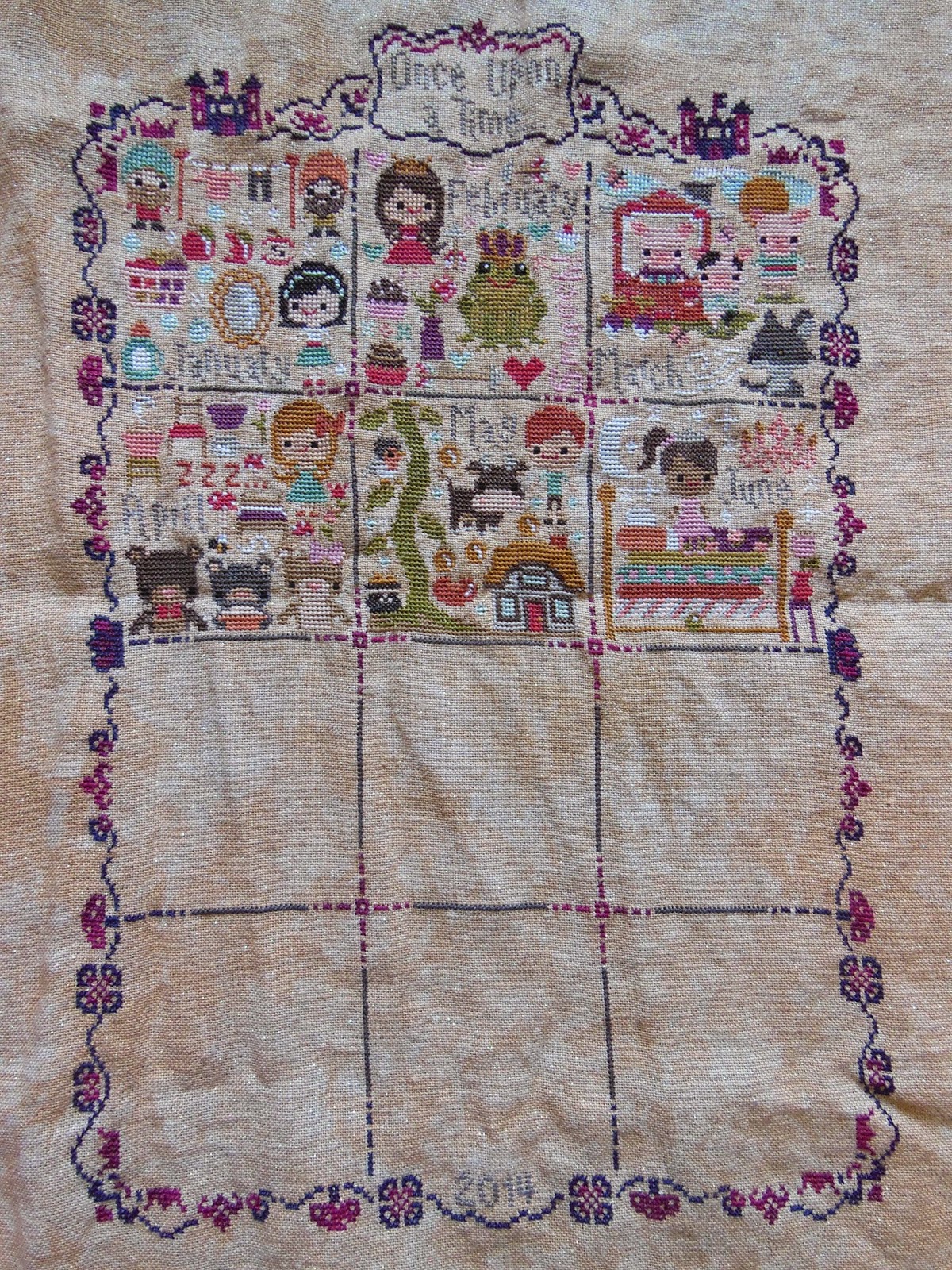
Just this morning, I finished the next square of the Once Upon a Time Sampler.  This month is Thumbelina.  I guess that means Hans Christian Andersen stories are a possibility.  Hopefully they won't chose "The Little Match Girl" for December . . .


She is sitting in a walnut shell.  I got a lot of good practice with backstitching, which is often used in more complex cross-stitch patterns.


I can't believe it is over halfway done!  Now is when I start wondering what the Frosted Pumpkins will go with for a theme next year . . .

Tuesday, July 1, 2014

Put Your Money Where Your Hoop Is

I never intended to let politics seep into this blog, but yesterday's SCOTUS decision made it unavoidable.

I first encountered Hobby Lobby in college, where there was a location nearby.  It was ok, with no discernible difference in quality from Michael's or Joann's.  Someone gave me a gift card for it.

Then a few years ago, I found out that Hobby Lobby was printing full-page ads in newspapers on the 4th of July.  An example of one ad is below.

The print is pretty tiny, so I will give you the gist of it.  This ad tells me, in no uncertain terms, that Hobby Lobby doesn't think I am really an American because I am Jewish.  I was born here, my grandfathers and other relatives fought valiantly for this country in WWII, and my great-grandfather carried his citizenship certificate around so much that it had to be held together with tape.  None of that matters to the Green family that owns Hobby Lobby.  Apparently, America is only for Christians--specifically, only certain kinds of Christians.

After finding out about these ads, I sent the corporate office a message saying that they have made it abundantly clear that they do not want me as a customer, and I would be taking my embarrassingly large craft budget elsewhere.  I have not spent one cent there ever since.

The information that has come out since then has only solidified my decision.  The store refuses to cover certain types of birth control, allowing their beliefs to trump scientific facts about how those types actually work.  One store got flack for telling Jewish customers who wanted Chanukah decorations, "We don't cater to you people here."  The Green family also has ties to Bill Gothard, a cult leader with the belief that fundamentalist Christians should rule America.  (You might have heard of him because the Duggar family of TLC's 19 Kids & Counting are his most famous followers--and he is currently embroiled in a sexual harassment scandal for taking advantage of young women at his organization.)

The recent SCOTUS decision perpetuates ideas about birth control that are factually incorrect.  It continues to stereotype birth control, and women's health in general, as optional or "not really medicine."  Most troubling, it places importance on some religious beliefs over others, and gives power to a group of people who do not want to stop until everyone believes what they believe (or at least, until everyone is following their rules.)

But what does all of this have to do with crafting?  On Ravelry, there is a Hobby Lobby fan group that specifically does not allow political posts because the controversy "doesn't change the yarn itself one tiny little bit."

The yarn might not change, but the money paying for the yarn should.  While I personally have boycotted Hobby Lobby for years, I was always reluctant to bring it up to other people.  When the students I worked with came in with craft supplies in Hobby Lobby bags, or a knitter at Warm Up America talked about buying a new skein of yarn there, I would cringe inside and stay silent.  Not anymore.  People are going to hear about why the store shouldn't get their money, and this court case will make it easier.

Here's a handy list of other craft stores to go to for supplies.  This list appears to be centered on the Pacific Northwest, so I also encourage you to check out your local craft stores and sources.


It's not realistic for all of our consumer decisions to reflect our values, but this is one case where it is important to me.  Make your crafting purchases send a message.

Thursday, June 26, 2014

Super Mega Project Update!

I've been productive the last few weeks, and all it took was spending every free moment stitching!

First, I finished the June square for Frosted Pumpkin Stitchery's Once Upon a Time Sampler.

June 2014--The Princess and the Pea
Six down, six to go!
The mattresses were fun with all of the different patterns.  That princess looks very well rested, all things considered.

Then I completed week 5 of Follow the White Bunny's Furry Nice class.  Now my polar bear has wonderfully textured fur on his face and body.


I love the way the light hits the fur when I hold the fabric at a tilt.  Next up--satin stitch on the scarf.

I have a lot on my plate (including some projects not related to embroidery) and REALLY shouldn't be starting other projects, but Frosted Pumpkin came out with the first part of their Mysterious Halloween Town Sampler.  I have been dealing with some health issues this week and this sounded like the kind of simple, meditative project that would help put my mind at ease.  My husband saw me working on it and said, "Jorie, it's not pumpkin weather!"  This adorable little town doesn't care.

These are my friends:  Russell Crow, Cameron Crow, Crow Diddly, Hugh Crownin, Gregory Peck . . .
Mysterious blank town
There is some method to the madness of working on spooky patterns in June.  The ladies at Frosted Pumpkin Stitchery asked for feedback on how people prefer to receive holiday or seasonal patterns.  People responded with the following answers:
  1. More time to work on each section of a multi-part pattern.  Some speedy stitchers can finish a section in one week, but the rest of us are mere mortals.
  2. Release patterns far enough in advance that people can finish them before the holiday.  For some reason, people stop wanting to work on Christmas-themed patterns after December 26.
The Frosted Pumpkins listened to the feedback, and have changed the Mysterious Halloween Town pattern release accordingly.  Starting in mid-June, they are releasing one section of the pattern each month.  The final section comes out in mid-September, with several weeks to finish the entire pattern in time for Halloween.  The timetable is perfect for people who are also working on the Once Upon a Time sampler.  This way, I always have some cross-stitch to work on.

Other updates:
  • The Torah mantle has been my most difficult project to figure out, but I think I've found a workable solution.  Hopefully, I will have pictures up soon.
  • Rebecca Ringquist at Drop Cloth featured my Filling Stitches Sampler on her blog!
  • I've been selected to be a summer guest blogger at &Stitches!  I will be writing two blog posts chronicling my and my friends' efforts to infiltrate the State Fair.


Tuesday, June 10, 2014

Furry Nice Embroidery Class--Week 4

I mentioned in a previous post that I had signed up for Follow the White Bunny's Furry Nice Embroidery Class.  The first three weeks of the class were easy, giving people time to find the supplies and transfer the fabric onto the pattern.

Week 4 coincided with the end of the school year.  I was finishing up class work for a certificate at the local university, dealing with an uptick in activity at my student organization-based job, and then my husband and I went on vacation.  My online class stitching slipped through the cracks.  Oops.

Luckily, there is some leeway with pacing for the online class, and I am finally able to do some furry stitching.  Here is how my little polar bear looks at the end of Week 4.


Eventually, he is going to get all of his fur filled in, a colorful new scarf, and flowers.

This project is a lot more delicate than what I am used to doing.  I am working with one strand of DMC cotton floss at a time.  I can't pull the thread very tight, otherwise it creates holes in the fabric.

The pattern deliberately leaves the polar bear's face and body free of any lines in order to allow for free-form stitching.  We have guidelines on what directions the stitches should be in so that the bear can have a life-like appearance, but there is no "wrong" place to put a stitch.  This is a big leap of faith on my part.  I had to keep assuring myself that this would be a polar bear in my style, and it didn't need to look exactly like the original.  So far, my crafty friends are impressed.  My friend Angela said that it has the feeling of a sketched drawing.  Cassie said that if I didn't enter it in the State Fair, she would cry.

The polar bear still has a long way to go before it is done, but I am learning a lot about texture and shading.  Stepping out of my comfort zone will give me more tools to use in the future, and that can only make my work better.