Pages

Monday, December 23, 2013

Crafting Therapy

I've had anxiety problems to varying degrees since I was 8 years old.  During one counseling appointment, my therapist gave advice on how to stop a bad train of thought--eat an orange.  When I laughed at the suggestion, he explained his reasoning.  More than other fruits, oranges are a very involved snack.  You have to wash it, peel the skin off, pick away the excess pith, split the different sections, squeeze out the seeds from each slice . . . It's such a meticulous, physical act that by the time  you are done eating the orange, you are not thinking bad thoughts anymore.  Your thoughts have switched over to the task at hand.

This underlying idea appeared again when I took a class on stress management in college.  We explored a wide variety of techniques--yoga, pilates, labyrinth walks, meditation.  Though it takes a variety of forms, all stress management techniques have the same, underlying goal:  they make you focus on the present, instead of worrying about the past or future.  Even eating a chocolate bar can be an exercise in stress management when you take the time to savor the moment.

I think this is why I feel the need to always have a project going, and why I feel like I've recharged my batteries for the week after going to Saturday brunch at Home Ec.  Whether I'm trying to make creative use of stitches or follow a cross-stitch pattern, embroidery helps my mind focus on something other than my (usually unfounded) worries.  Depending on how much distraction I need, I can get a lot done this way!  When people asked how I managed to get the February Drop Cloth Sampler of the Month finished in two days, I responded, "I worked on it while waiting for a paper grade."

It also makes me feel productive in the face of bad circumstances.  When I was dealing with a long period of unemployment, I told my husband that I felt like I wasn't accomplishing anything important.  My husband responded, with utter conviction, "Yes you do!  You knit blankets that keep babies warm!"  When my friends gather for Saturday brunch at the store, we often end up talking about the hardship in our lives--unemployment, health problems, family issues, gloomy love lives.  We met and talked the day after the Sandy Hook shooting, and the day after the manhunt for the Boston Marathon bombers.  At the same time we show off our latest projects that are, more often than not, for other people.  A wedding gift for a friend.  A baby sweater for a niece.  A snazzy treehugger to show off downtown.  A blanket for the hospice.

The past several weeks, I've been working on a special piece.  I held a fundraiser for the local women's clinic in which I raffled off handmade items.  One of the prizes was for the winner to have her favorite quote embroidered by me.  The winner ended up selecting a quote from Winnie the Pooh that inspired her during a difficult period in her life.  I've just finished the words, so all I have left is some embellishment and the framing.

"Promise me you'll always remember:
You're braver than you believe, and stronger than you seem, and smarter than you think."--A.A. Milne
We can't control every force governing our lives, but we can always create something beautiful in the middle of chaos.

Wednesday, November 20, 2013

Stitcher-view with . . . Angela!

I've been lucky to find wonderful stitching friends.  In this feature, read about what inspires them when it comes to embroidery.

Today, we meet Angela, another Home Ec regular.  Angela's background is in photography, but she is also an avid knitter and, more recently, embroiderer.

Q:  How old were you when you learned to embroider?  Who taught you?
A:  My mother taught me to hand-sew when I was, oh, seven years old or so, I think--running stitches and back stitches and buttons and such.  I think about what I'm doing now as an extension of what I learned as a kid.  It feels the same to me as hand-sewing, but with fancier patterns, sort of like lace knitting is still a kind of knitting, but with specific arrangements of knits, purls, and yarn overs.  

Q:  Why are you drawn to embroidery as a craft? 
A:  Well, I'm obsessed with the Iowa State Fair.  I've gone at least once a year since I moved to Iowa in 2007.  Since I sew and knit, the fabric and threads division is one of my favorite places to check out (well, along with the butter cow and the smoked turkey legs).  I've always been impressed with the variety in the knitting, quilting, and crochet on display, but the embroidery seemed stuck in a very sweet, cherubs-and-inspirational-sayings, kind of style.  And I'm kind of a contrary person.  Every year I would think, "Someone should really shake this up!"  After a while I thought, well, maybe I should.  Now I have a set of tea towels to submit for next year, except instead of inspirational quotes they have excerpts from Sylvia Plath poetry.  And pillowcases that say "Ask me what I'm asking for."

Pillowcase embroidered by Angela

So I was first drawn to embroidery as a way to engage with both the literal space that it occupies at the fair, and the imaginative space it occupies in our culture.  I wanted to work with the context and the history and the assumptions that go along with it.       Once I got started on state fair projects, I also started to appreciate the qualities embroidery has to offer as a medium, and not just it's cultural associations.  I think embroidery lends itself really well to text, which is another interest of mine.  I've been thinking about approaching embroidery as a kind of calligraphy, a way of slowing down and focusing on the shape and space of letters and the craft of forming them just so.  (I still have a long way to go with that part!)     And, if I'm going to be perfectly honest, I often covet the awesome things people make around me, and I've been admiring Cassie's work for years.  So the idea has been kind of percolating for a long time.


Q:  What are your favorite and least favorite stitches?
 A:  The only stitch I use right now is chain stitch.  My absolute favorite stitches to look at are blackwork. 

Q:  What is your favorite thread and fabric? 
A:  The basics: plain cotton fabric and embroidery floss.  I suppose eventually I'll have an idea that would be better suited to other materials, but right now there are too many possibilities with just those things.

Q:  What types of projects do you like to work on?
 A:  Text, mostly.  I've been working with poetry or slogans that resonate with me.  I think written language is beautiful, not just in the imagery and emotion it can conjure, but the actual lines on a page, the shape and movement of letters.  I've recently started a year-long project--all 131 lines of T.S. Eliot's The Love-Song of J. Alfred Prufrock--so it will be a while before I have a chance to think about what other projects I like.

Q:  Where do you find inspiration? 
A:  A lot of my ideas start out as "wouldn't it be great/impressive/funny/ridiculous if someone did ___?"  I make the things that I wish existed.  Either that, or I make the thing I wish were mine.  My current project started because I use a light table to trace my design onto fabric, and every time I do that I think about how beautiful the fabric looks when lit from behind, and what if that were the intended display?  What kinds of ways could someone manipulate the effect of the light through fabric? Someone should do that!  I'd already been thinking about the T.S. Eliot, and how ridiculous it would be to try to embroider the ENTIRE poem.  And now I'm embroidering the poem on fabric to make light boxes out of.

Embroidered by Angela
Q:  Are there any types of embroidery or skills that you would like to learn in the future?
A:  Some day I would like to make something with a lot of smocking because I think of hand-smocking as, like, the Olympic Gold Medal of hand-stitching.  People who do hand-smocking are the BAMFs of threadwork.  And some day I'd like to make the kind of Chinese embroidered "paintings" that I grew up with.  It's all long-and-short satin stitch, but the skill difference between my satin stitches and the ones in the tapestries is monumental.  So... I want to make a prairie bonnet and a Chinese tapestry.  :)  Some day.  Oh, and since I'm making light boxes, I need to learn woodwork.  I'm terrified of power cutting tools, so it's kind of daunting.  (My fingers are useful.  I would like to keep all of them attached.)  And I'd like to re-attempt the Master Knitter program and get further than three samples.  And weaving, and quilting, and getting back into calligraphy, and--


Check out Angela's other works in progress at her website!

Monday, November 18, 2013

Stitcher-view with . . . Cassie!

I've been lucky to find wonderful stitching friends.  In this feature, read about what inspires them when it comes to embroidery.

Today, we meet my friend Cassie.  She is one of the regulars at Home Ec's Saturday brunches, and she recently opened StitchinBliss, an Etsy shop to sell hand-embroidered wedding handkerchiefs.

Q: How old were you when you learned to embroider? Who taught you?
A: What counts as embroidery, and what counts as learning? Before I was seven years old--five, maybe, but I remember most things that happened around then as belonging to five--I had a needlepoint kit. The printed picture was of a rainbow and a cloud, and my mother showed me how to make the diagonal stitches. I remember the pink plastic needle much better than I do the picture itself. Sometime before or during seventh grade, I learned some amount of cross-stitch, though I can't remember if I learned it in an intramural club or not.  
Then, at . . . um, an age probably larger than twenty-six but not larger than twenty-eight? Numbers! Argh! Anyway, as an adult, I took an embroidery class at Home Ec Workshop. A friend of mine had taken an earlier session and made a sampler with the motto, "Dissertate This," to support her as she finished her PhD, and I liked the idea of doing something fussy and bright. Codi Josephson, the teacher, had screen-printed the sampler in white on a variety of colors; because I am me, I took white fabric. She led us through basic stitches as well as showing us resources to learn more and did a great job balancing the skill levels of the class. I had read about embroidery and needed practice, a mother and young daughter were learning together, and another student, JoAnne, showed us an embroidered portrait of her cats that looked ready to purr. Teal deer: I learned as an adult, but I had a soft background in sticking needles into things.

Q: Why are you drawn to embroidery as a craft?
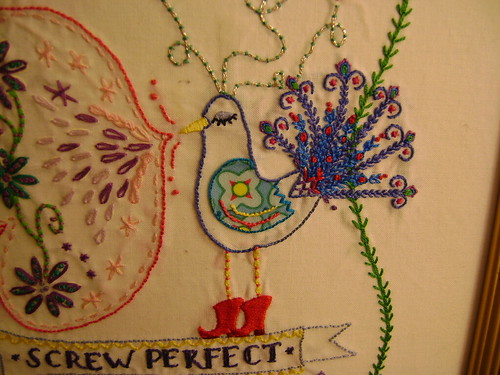
A: Honestly, at first, because everyone praises me for my tiny, precise stitches, and no one else was doing it as well as I was! I will not hide my shallowness. I live with spinners, one of whom is learning to weave, I eat breakfast with a Master Knitter on Saturdays, other friends do incredible colorwork, lace, or amigurumi food, and I need as many sewing lessons as my sewing machine needs work to run properly. Surrounded by people with incredible crafting skills, where else can I be best? Of course, now there are quite a few embroiderers in my circle, but I wouldn't give them (and you) up to regain my throne as No Seriously How Did You Do That Queen. I like embroidery because I can mess with it easily. I mentioned the seventh-grade intramural class--we had small pictures with teddy bears in various outfits and I took the snorkeling bear. But the snorkeling bear was a boy! Wearing a Speedo! This could not happen. So I made him into a girl wearing a pink two-piece. Likewise, the original Home Ec sampler class: I changed the wing on the bird because I didn't like the printed one. I added eyeshadow and bright red cowboy boots. I used couching where the sampler had stem stitch. I threw in scalloped stitches on both sides of the banner. I layered chain stitches to make the flowers, I did twice as many feather stitches going up the sides because I liked the look, and I decided my bird was a damned fine peacock, thank you, and she was going to have a tail. Go look at that tail. Admire the tail.  
Embroidered by Cassie

I don't know how to do that with knitting, not really, nor sewing. Embroidery gives me a lot of room to play. I designed a piece for a friend and made it look exactly right-- no worry about having the right center but wrong border, no gauge to match, just drawing the picture and spending forever and a day stitching it. Embroidery's also faster when I work on it steadily. Doesn't happen often, but it's satisfying.

Q: What are your favorite and least favorite stitches?
A: I don't know that many stitches, to be honest. From the beginning, I loved stem stitch because it looks so even and ropey. I have never liked split stitch; it's difficult to do and looks ragged. I don't like that they teach it in high school home ec classes because no one can make it look good. Backstitch always surprises me when it looks like anything other than bricks, so I guess I dislike it on paper but like it once I'm done with the project. I really like chain stitch, though I do mine backward--I do a lot of stitches backward, actually, because it's easier for me to pass the needle under an existing stitch that to gauge where the needle will come out and catch a half-formed stitch that way. I should add that I like chain stitch when it's done as small as possible. Half the reason I added the layered flowers to my Home Ec sampler was that the original petals were too big and looked sloppy! I also like couching because it goes fast. For projects that need quick writing, I use couching.


Embroidered by Cassie
Q: What is your favorite thread and fabric?
A: Can I skip this question? I use DMC floss and flour-sack towels muslin from JoAnn Fabrics. I've also used lace-edged handkerchiefs and recently acquired Irish linen. I like fabric that's even and fine enough for me to put stitches exactly where I want them. A word of advice for all stitches: don't use foil floss lightly. It will break your needle-threaders and frustrate you to no end. It's a good material once you're done with it, but it will make you hate the world and all its textiles.

Q: What types of projects do you like to work on?
A: I like projects I can alter to suit myself--I'm working on printed towels for a friend now and am not sure how I'm going to change the pattern beyond 'subtly'. I like projects with some humor to them. I love bright colors and rainbows. I like striking images and contrast. Sometime I'm going to do an embellished fabric (Home Ec has a couple I must have because leaves and birds and mine), but I have a few projects in my queue first.

Q: Where do you find inspiration?
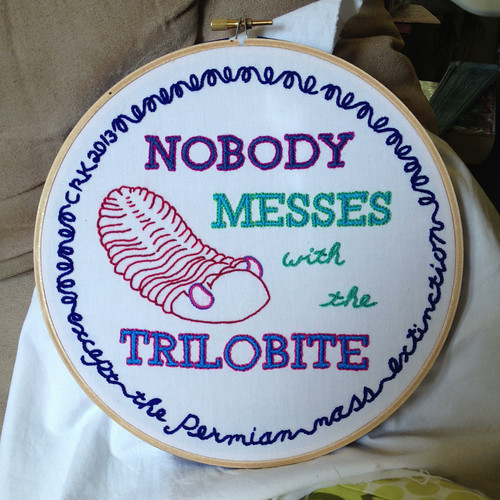
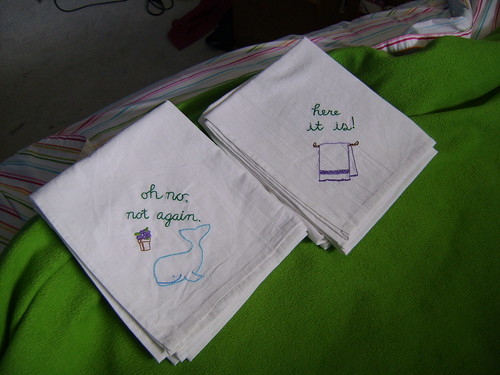
A: So far, with limits. "Make me something," doesn't work. "I like trilobites and here's a quote about them," leads straight to a year-long project. "The State Fair wants a pair of towels," means I have to find a pair of ideas I like. "I'd love an embroidered wedding handkerchief," and the art from the invitation work together. For my embroidered book cover, I used a cool background fabric because my collection of floss is about half blues--I've never had to use my reds and oranges and I wanted to force myself to look at them the same way I do my beloved blues. I think that many people don't realize the value in limits. By eliminating almost all of what is possible, the remaining infinity suddenly seems broader. I'm also likely to subvert whatever I'm doing, or at least to think I am. A good friend of mine once said, of writing, that your first idea is almost always crap because it's easy. The second or third ideas will be better. It's not that I think traditional embroidery is terrible--far from it!--but I'm much more likely to make and use a set of napkins that makes me giggle than to follow the iron-on pattern exactly.

Embroidered by Cassie

Q: Are there any types of embroidery or skills that you would like to learn in the future?
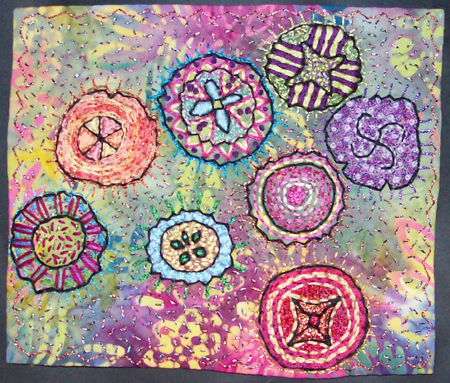
A: Discipline? Theme of my life. I'd like to expand my vision and ideas so I have more flexibility in what I can do. Look at Carolyn's pictures! I never would have thought to do the abstract diatomish circles. I'd love to learn blackwork and other very precise filling techniques; every year at the State Fair, I take a picture of *something* blackworky. And framing! And more designing! And there must be a project out there that would make knots make sense, so that. Oooh, embroidering clothes....!

See more pictures of Cassie's projects at her Flickr page!

Saturday, November 9, 2013

Stitcher-view with . . . Carolyn!

I've been lucky to find wonderful stitching friends.  In this feature, read about what inspires them when it comes to embroidery.

Today, we meet my friend Carolyn.  We met in a Home Ec class on embroidered embellishments, and have stayed in touch ever since!

Q:  How old were you when you learned to embroider?  Who taught you?
A: I was around 14-15 when I learned to embroider. My mom taught me.

Q:  Why are you drawn to embroidery as a craft?
A: I am drawn to embroidery because, for me, it is very relaxing, portable, in-expensive, and the possibilities for design are endless.

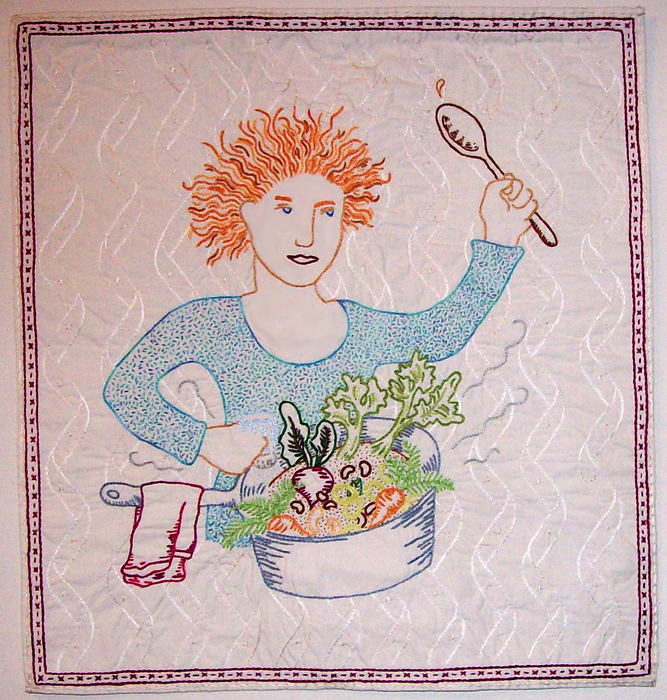
Vegetarian Epicure image, "Cook with Spoon" drawn by Julie Maas
Embroidered by Carolyn

Q: What are your favorite and least favorite stitches?

A: Favorites: back stitch, seed stitch, split stitch. Least favorite: none.

Q: What is your favorite thread and fabric?
A: I primarily use DMC 6 stranded floss. I also love Kreinik metallic floss. 

Q: What types of projects do you like to work on?A: When choosing a project to work on, I am drawn to images that make my heart go, "Aaaaaah! I HAVE to stitch that." Follow your bliss! If the pattern/picture/image doesn't make my heart sing, I won't bother with it.


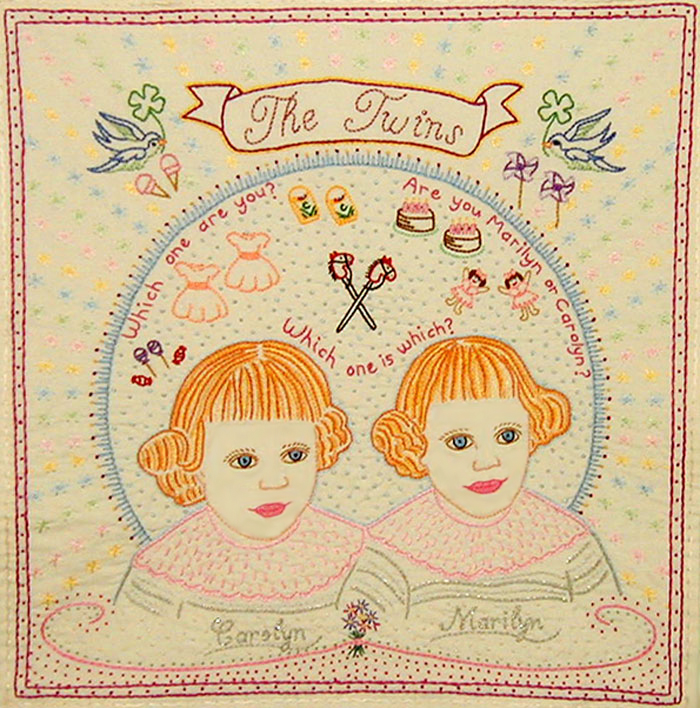
"The Twins" by Carolyn
Based on a photograph of her with her twin sister
Q: Where do you find inspiration?A: I use Google and Pinterest a lot. I just found two Winter (not Christmas) patterns (via Pinterest) that I am going to start on this weekend. 

Q: Are there any types of embroidery or skills that you would like to learn in the future?A: I am toying with re-learning crochet and using crochet with embroidery.
Embroidered by Carolyn
To see more of Carolyn's work, visit her website!


Wednesday, October 30, 2013

What's My Worth?

Several weeks ago, right before Yom Kippur, I ran into the husband of a woman I am on a board with at the synagogue.  When I introduced myself, he said, "Wait, are you the one who does embroidery?"  Yes, I am.  "So you are the one who submitted that matzah cover to the state fair and got a ribbon?"  Wow, word travels fast!

He said that he has a project that I might find interesting.  Every year at the Kol Nidre service that starts Yom Kippur, my Jewish community has a tradition in which all of the torahs in the community are carried into the service and up to the bimah [stage].  (At this point, I was assuming that he was going to ask me to carry a torah during the procession.  I would have to politely decline since I haven't lifted weights in a while.)  He went on to say that his family owns a torah that they have always included in the ceremony.

When not in use, a torah is protected with a cloth covering called a mantle.  They are often very ornate, made with fine fabrics and embroidered using goldwork techniques.  During the rest of the year, they can be any color or design, but in the 10 days between Rosh Hashanah and Yom Kippur, synagogues traditionally switch to white mantles to represent our purity after atoning for sins.

Antique reproductions
The man said that he sewed a torah mantle for use during the 10 days with cloth from a wedding dress that had been in his family.  When he first made it, it had a Jewish star and torah stitched on with surface embroidery.  Since then, he has decided that he wants a more complex pattern--more colors, more Jewish symbols.  He has not been able to add more because he doesn't embroider, and he has had trouble finding someone who was both talented and familiar with Jewish symbols.  When he found out about my matzah cover, he decided to ask me.  He said that he could pay me, and we agreed to talk more after the High Holidays.

I was so elated that when I got home, I cranked up my music and danced around.  (Not to Jewish music.  I think it was "Down Under" by Men at Work.)  I felt honored to be asked to work on such an important object, and that someone would actually pay me to do it!  Then it started to sink in . . .

Pay?  PAY?  What on G-d's green earth am I going to charge?

It's a question that every crafter with a home-based business must grapple with at some point.  You have to consider the cost of materials and tools.  You have to decide on a dollar amount for the time you put into the project--your time and effort has value, and the price of the item needs to reflect that. At the same time, we are living in a world where we are so used to mass-produced items that the cost of a handmade item can produce sticker shock.

We were discussing this during brunch at Home Ec because the local library is holding its 2nd annual Arts & Crafts Bazaar.  They are accepting handmade items, which you provide with a suggested price.  The items are then sold at the Bazaar and the money goes to their summer reading program.  Several people said that they had contributed high quality handmade items--both in material and technique--only to discover that the items were sold at less than their suggested price.  This year, they are reconsidering how many items they donate, they are using cheaper or leftover materials, and they are choosing items that don't involve as much of a time commitment to make.  One Home Ec patron said that her friend used to donate knit items to her church's fundraisers, but eventually stopped because she was so hurt by the way that the organizers constantly underpriced her items.  We want to help worthy causes, but we also want our hard work to be adequately recognized.  Non-crafters do not know how many weeks it took you to knit that Fair-Isle hat, or the eye strain and finger pricks you endured while stitching a monogram onto a handkerchief with one strand of floss.

I think it makes sense to tailor your price, crafting technique, and expectations to where your items will end up.  The goal of a fundraiser is to make money for the organization, so items need to be priced to sell that day.  Save the higher quality materials and complex skills for times when customers will be expecting to pay higher prices, such as an Etsy store, a craft fair, or custom work.  Browse the internet to find out what the prices are for similar handmade items.

I also don't know whether I should factor my experience into the price.  I will be putting in my best work, but should I lower the price since I do not have years of experience behind me?

Whatever the answer, I will take care in finding it.  When I receive the torah mantle. I will take it to the owner of Home Ec to ask for advice on materials and tools.  I will keep scouring websites to get ideas on prices, and I will ask for honest opinions from my crafting friends.  Above all, I will see this as an opportunity to grow as a Jewish embroiderer--and that is priceless.

Thursday, October 24, 2013

Stitching Shakespeare (Part 2)

I finally finished the stitching on my special Shakespeare project.


This was my first time working on a completely original design, and it was a really valuable experience.  Before working on each section, I would hold up the cloth and examine it, trying to consider what colors and stitches would look best in that section.  At the same time, I also learned that it is fine when a particular choice doesn't work out, because I can always take out the stitches and start over.  Like knitters, stitchers refer to undoing work as "frogging" because you have to "rip it, rip it, rip it."  (Someone on the Frosted Pumpkin forum referred to it as "the frog visited," which sounds like a euphemism for something else . . .)

Adding the embellishments to the peacock was especially fun.  This is a newer trend among embroiders.  You take a piece of fabric with a bolder design on it, then stitch on top of it in a way that either brings greater detail to the design or adds a picture on top of the fabric.  One fiber artist takes traditional French fabric with a pastoral design on it in blue and white, then adds subversive changes--like giving a dairy maid a mohawk and fishnet stockings.  In my case, I added the details to both punch up the colors and give the peacock a more textured effect.  The result has a lot more depth than the fabric design alone.  The embellishments also emphasize the theme of the quote.  As one of my Home Ec friends said, "The quote is about how it is hard to hide your nature, who you really are, and the peacock is flaunting what makes him special."
Outline:  blanket stitch
Head feathers:  french knots
Top wing:  backstitch outline, seed stitch filling
Wing feather:  fern stitch
Tail feathers:  blanket stitch outline, french knot center
Flower:  Algerian stitch
It was surprising to me how liberated I felt stitching my handwriting.  I have never had very attractive cursive or printing.  I used to write in cursive on tests because it was quicker, but I gradually switched to printing because I was worried that professors wouldn't be able to read my cursive.  I got used to the idea that my cursive handwriting was rushed and illegible.  When I wrote the quote for my project, I didn't deliberately change my handwriting, but it looked inherently different because I took my time and was not writing under the pressure of an exam.  I was able to take a part of me that I was always ashamed of and turned it into a beautiful work of art, with its own character and style.


I had to share this because I was so happy to get the stitching done, but the project isn't complete yet! Next time, I will describe my first venture into framing--a step that bring anxiety to many beginning stitchers.

Wednesday, October 16, 2013

Project Round-Up--10/16/2013

Sorry for the lack of updates.  I got a bad cold last month that I am still getting over, and I learned from a disaster with a lace knit scarf that crafting and illness don't mix.  Once I was feeling better and more energetic, I was able to complete some cross-stitching on my Frosted Pumpkin Stitchery Woodland Sampler.


This is my favorite block so far.  The hedgehogs are adorable, and it really helped me get into the autumn spirit when we were experiencing a 100F heatwave in September.
The pattern calls this adorable owl "Oliver," but my husband has named him "Hootie."  I really like the design of the oak leaves.

The ladies behind Frosted Pumpkin have started a Facebook group for fans.  There's a lack of forums on the internet to discuss hand embroidery and cross-stitch, especially with more modern designs, so I've enjoyed having a place where people can post pictures of their projects and get advice on materials and technique.  We have even gotten sneak peeks of upcoming patterns!

It looks like the next year of seasonal samplers will be holiday-specific.  Halloween is not really my thing (I don't care for holidays that require you to find a raucous party) and I am not interested in the Christmas patterns for obvious reasons.  That gives me time to finish up the previous seasonal samplers and look forward to the 2014 yearly sampler.

Other updates:
  • I was avoiding the Satin Stitch sampler from Drop Cloth while I finished the Frosted Pumpkin squares.  I started that, but I am also working on the Cross Stitch sampler to satisfy my need to finish an embroidery sampler quickly.  (As I will discuss soon, satin stitch is slooooooow.)
  • I have finished the stitching on a project I wrote about previously and will be posting pictures soon.  In order to really showcase its beauty I have been trying to get good pictures of it, but the autumn clouds and the poor lighting in my apartment are making that difficult.
  • As part of a fundraiser I organized, I raffled off the chance for the winner to receive their favorite quote embroidered by me.  I'm really excited to work with the winner, who just sent me the quote she wants.